

Quality of Service (QoS) allows achieving a high output by the ability of DPI technology to classify all traffic by priorities, providing wider bandwidth to certain applications and protocols.
Availability and high quality of service are the main indicators of the provider’s performance. Such problems as slow pages’ downloads and stuttering sound during video calls are very annoying for users. These issues can be improved by managing QoE (Quality of Experience) with the QoS function of the Stingray platform.
QoS helps a network device (router or similar) to optimize traffic to be sufficient for the applications which are critically important for users. The service can dynamically apply various methods of differentiation to traffic. It is mostly applicable in IP telephony, IPTV, video conferencing, and other delay-sensitive services.

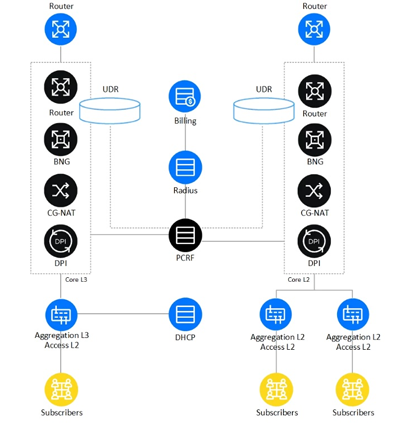
The BNG/BRAS (Broadband Network Gateway or Broadband Remote Access Server) is a function of the Stingray SG platform for authorizing and terminating IPoE/PPPoE subscribers. This solution allows an ISP to control subscribers’ connection to the Internet by IPv4/IPv6 protocols, apply policing and additional services.
The main object of BNG is to authorize users and apply tariff plans
BNG as the Stingray Service Gateway function provides an opportunity to improve Quality of Service and the way the user perceives it (QoS and QoE). Stingray analyzes traffic at levels 2-7 of the OSI model and handles the protocol data units according to rules applied to them. This allows the broadband operator to use traffic balancing within each uplink, for each subscriber, and for all traffic within the device.
Traffic can get a mark from Stingray SG and be passed further on for prioritization on the router. The platform itself can control the bandwidth according to the algorithms (HTB, TBF) for each of the 8 traffic classes, which are determined on the basis of signatures (instant messengers, streaming video, social networks, torrent, etc). CG-NAT and 1:1 NAT are available for all authorization types in the BNG solution. IPv4 address translation allows saving address space and gives flexibility in cases if private and public addresses are provided to end subscribers.
Usage of the policy server (PCRF) allows ISP to load balancing across several BNG with synchronized subscriber authorization statuses. PCRF is also responsible for the redundancy of numerous BNG and the flexible configuration of interaction with Radius.
BNG generates a request to the billing system via Radius protocol on the first data packet from the subscriber and receives back a set of connected services. This functionality is implemented for L3 (IPoE) and L2 (DHCP, PPPoE, Static IP) modes with Dual Stack IPv4/IPv6 support.
NAT (Network Address Translation) solution is used in TCP/IP networks. It allows replacement (literally – the “translation”) of the private IP address with a public one.
Carrier Grade NAT by VAS Experts — a flexible and cost-effective solution for Internet service providers, already tested on more than 1,500 networks. The solution allows you to transparently replace a private IP address with a public one, and with the help of Dual Stack v4-v6 to invalidate the limitations of NAT44.
NAT/CG-NAT significantly expands existing networks’ capacities. As today the limit of IPv4 addresses is almost over, the transition to IPv6 is inevitable. The rapid growth of mobile devices and cloud services in use makes this task even more urgent.
IPv4 addresses from the regional Internet registries (RIR) are no longer available. The only way is: to purchase a large pool of IPv4 addresses from a broker. This makes single IPv4 address cost raising constantly.
Stingray SG solution is designed for telecom operators and Internet service providers; it is also the suitable replacement of NAT equipment in corporate networks. Having a range of functions and possibilities, Stingray is to fit any growing network and to adapt to it.

Provide one public IPv4 address to several subscribers without loss of Internet connection quality — up to 100 private IP addresses can be placed behind one public IP address (ideal ratio — 1:10)
Extend the use of limited IPv4 address space and reduce the cost of buying IPv4 addresses by 90%
Prepare for the implementation of IPv6 addressing by supporting Dual Stack v4-v6 (support for both protocol versions at the same time)
Quality of Experience (QoE) is a software product responsible for gathering statistics and evaluating subscribers’ perception of services. DPI-based QoE metrics help to increase customer loyalty, monitor the network and increase ARPU from each subscriber.
The statistics are transferred to special metrics that allow user experience evaluation. It provides the operator with the information: whether the subscriber gets high-quality Internet communication or not; what kind of problems does he/she encounter.
With QoE, you can monitor your network state in automated mode, compiling all the necessary information – subscribers’ data, devices in use, tariff plans, etc. – integrally. The entire compilation or parts of it can be forwarded to various back-office Depts., namely Tech, Sales or Marketing, for more efficient operations.
Based on the precise data rather than on even the best guesses, it is easier for a provider to make optimal decisions. Which, in the end, results in ROI and ARPU growth.
The data obtained allow the operator to take action and to improve the quality of the services – resulting in increased customer loyalty.
The key metrics are: